Astronomy at Augustana: My journey


I have always known that I wanted to study astronomy, and coming to Augustana College has allowed me to explore many different areas of astronomy and astrophysics. Ever since my first year, my semesters have been filled with conferences, trainings and hands-on experience that has prepared me for my future in this field. Many of my opportunities have been made possible by Augustana’s involvement in the MACRO Consortium.
What is MACRO?
The MACRO Consortium consists of students and faculty from Augustana College, Coe College, Knox College, Macalester College and the University of Iowa. Using the Robert L. Mutel Telescope (RLMT) located in Sonoita, Ariz., we are able to make observations that would otherwise be impossible given the light pollution around our respective campuses.
I became involved with MACRO during the spring of my first year at Augustana. Advised by Dr. William Peterson, I presented my poster, “Paradigm-Shifting Observations Using a Small Student Telescope,” at the 2024 American Astronomical Society Conference in Madison, Wis. This work showcased the power of the RLMT by recreating the famous Hubble Cephid Variable experiment.
The MACRO Summer Program 2025: Exploring new wavelengths
The summer after my sophomore year, I was invited to participate in the MACRO Summer Program. In this program, we focused on Magnetic Cataclysmic Variables (MCVs), which are binary star systems containing a white dwarf that accretes mass from a lower mass companion star.
During the first few weeks of the program, we took a deep dive into the physics behind MCVs with MACRO directors and guest speakers. About halfway through the program, each participant was asked to choose a wavelength in which to study these fascinating systems.
Though the optical and x-ray processes were interesting, I ended up choosing to study these systems using radio astronomy.
The radio group’s goal was to investigate the presence of radio variability in the eclipsing cataclysmic variable system LX Serpens. This experience was both exciting and intimidating.
Though radio astronomy had some similarities to the optical data I had previously worked with, it was still quite a change. Among the many challenges was learning how to use the Common Astronomy Software Applications (CASA) package which is used to process the radio data from the Very Large Array. As we developed a clear goal for the project and played around with the different functions, I slowly gained some comfortability with CASA.
Though I am nowhere close to being an expert, this research project gave me the confidence to jump into learning new systems. I had the privilege of presenting a poster on our research at the 2025 Society of Physics Students Conference in Denver, Colo.
MACRO preceptor training
At the start of my junior year, I was honored to be asked to participate in a training to become a preceptor for RLMT data. After completion, myself, along with a group of dedicated students from other MACRO institutions, learned the ins and outs of the RLMT.
The preceptor is responsible for nightly scheduling of the telescope, taking calibration images, checking for image quality and distributing images to the proper places. After the images pass initial quality checks, they are used for university classes, personal studies and ongoing MACRO research projects.
Trip to Winer Observatory
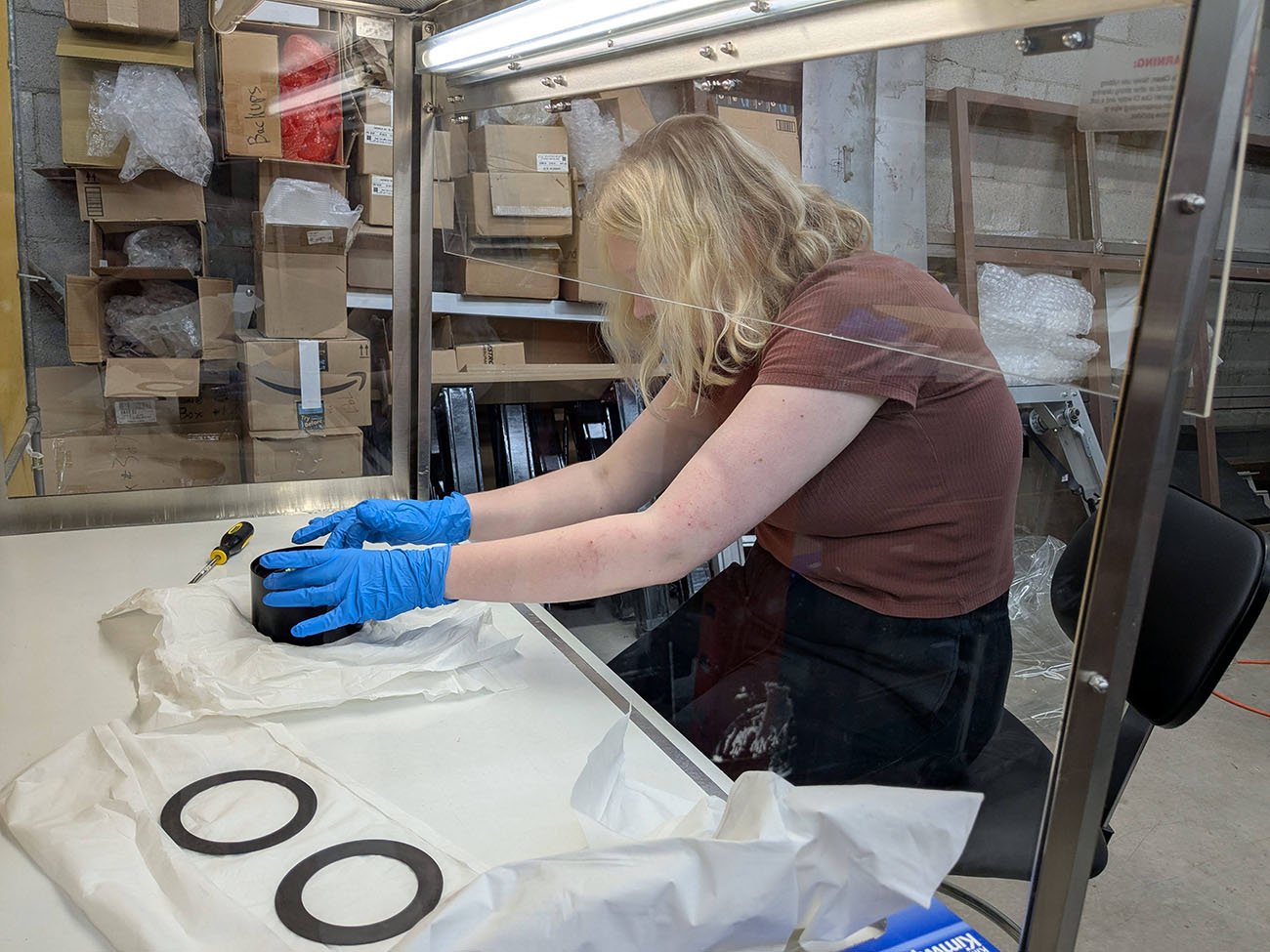
During my training to become a preceptor, I traveled with Dr. William Peterson to the Winer Observatory in Sonoita, Ariz., to do maintenance on the RLMT. There are many types of tasks that need to be completed to get the telescope ready for observing season, and since I was in the earliest student group to arrive at the observatory, our first priority was cleaning the telescope.
Unsurprisingly, Arizona is a very dusty place! To make the calibration process easier, we had to clean the mount, mirrors, filters and more. Before we attached the freshly cleaned components to the telescope, we tested out the light-tightness of the camera’s new casing.
Finally, we reassembled the telescope so that calibration frames could be taken. Installing this new casing had a noticeable effect on quality of RLMT images; the less unwanted light hitting the sensors, the better. Following the telescope’s back-end reinstallation, we took sample images, troubleshooted software difficulties, and soon enough, it was time to pass on the maintenance to the next incoming group.
Advice for the future astronomy student
During my time working with MACRO, I have explored many areas in astronomy. From hands-on maintenance and scheduling experience to presentations at professional conferences to special topics courses and trainings, I have gained insight into the various paths I can follow into graduate school and beyond.
To the future Augustana astronomy student, follow your passion and stay curious, and the opportunities will come!
Emma Biskie ’27 is a physics and mathematics double major with an astronomy minor from Rock Island, Illinois. She leads astronomy in the Physics and Engineering Society, serves as social media chair for the Math Club, and plays oboe and English horn in the Symphonic Band.