
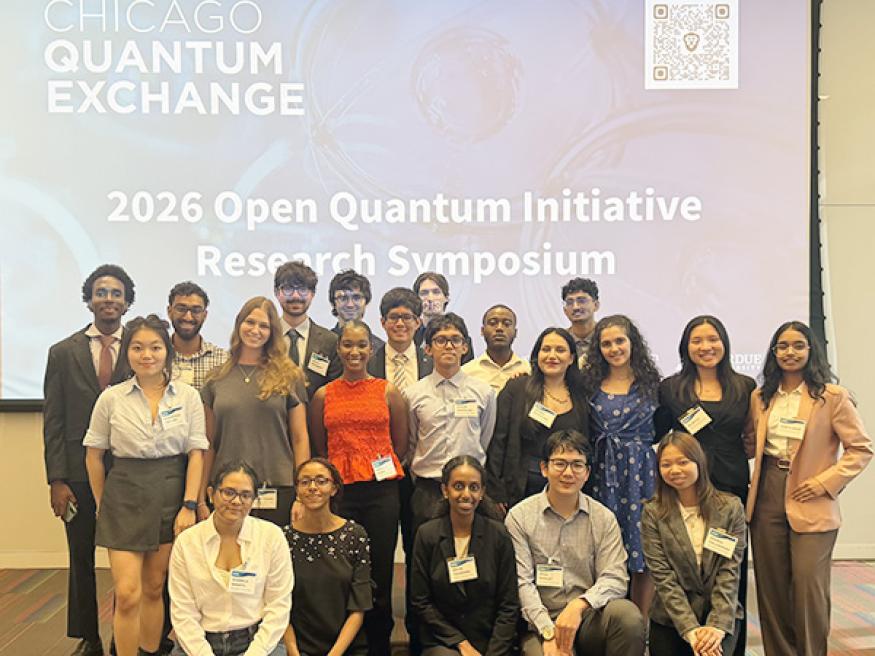
Physics major Cholo Ferrolino '27 (second row; fourth from the left), and his fellow interns from colleges and universities nationwide attended the Open Quantum Initiative (OQI) Research Symposium in Chicago this summer.
Augustana’s Cholo Ferrolino helping to build a ‘Chicago-area quantum ecosystem’
When physics major Cholo Ferrolino ’27 received a prestigious summer fellowship in quantum science and technology — the Open Quantum Initiative (OQI) fellowship through the Chicago Quantum Exchange (CQE) — he opened a pipeline for Augustana students of quantum physics to assist with research toward building the quantum internet.
Unlike the classical internet, which connects devices using standard binary information, the quantum internet uses quantum bits, or “qubits,” which can exist in multiple states at once. Quantum communication using qubits can create unhackable data transmission to interconnect quantum computers, leading to new capabilities. Current examples of technology impacted include autonomous navigation, medical imaging, and environmental sensing and monitoring.
One of 22 fellows from colleges and universities nationwide, Ferrolino spent his time in the lab at Northwestern University’s Center for Photonic Communication and Computing, headed by Dr. Prem Kumar.
Why build a quantum internet? It may sound like science fiction, but as Dr. Kumar pointed out, so did meeting over Zoom, not too long ago.
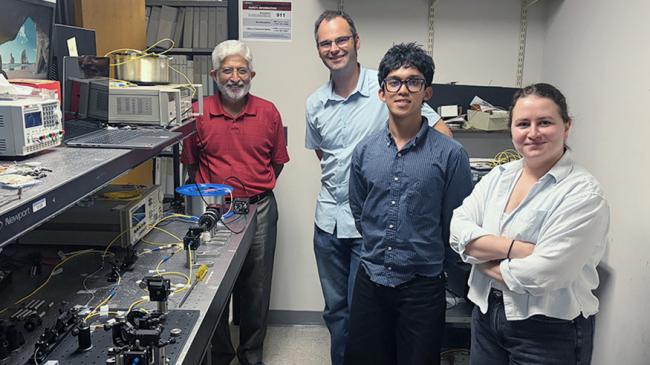
Left to right, Dr. Prem Kumar, Dr. James van Howe, Cholo Ferrolino ’27 and Dr. Gamze Gul
“That technology did not happen overnight; it evolved over time and it took almost 50 years to get there,” said Dr. Kumar.
“Now, quantum computing is developing rapidly, and similar issues are coming up. People are asking, what would happen if we inter-connect these quantum computing resources? Is it technologically relevant in the sense that it can help solve humanity’s problems — whether discovering new drugs, creating better fertilizers for the environment, understanding how AI is working or designing new chemicals?
“These are ambitious goals, just like in the ’50s and ’60s we had ambitious goals.”
Dr. Kumar said the work they are doing in his lab is a very small step along the way. “And of course one has to go into the weeds, and identify the problems and work on them. So, Cholo and others in our lab — all are working on this.”
Professor’s research opens doors for students
The opportunity came to Ferrolino from his mentor Dr. James van Howe, an Augustana physics professor and friend and colleague of Dr. Kumar. Dr. van Howe had spent a sabbatical at the Center for Photonic Communication and Computing, working closely with Dr. Kumar and Dr. Gamze Gul, also of Northwestern.
Dr. van Howe and others are collaborating on a “Chicago-area quantum ecosystem.” They are testing quantum networking protocols using a Quantum Wrapper Network (QWN) setup co-invented by Dr. Kumar.
“Much of the infrastructure is already built,” Ferrolino explained in his presentation to other OQI fellows and faculty at the Open Quantum Initiative Research Symposium midway through his internship. “We can use the vast system of optical fiber in the ground, over aerial cables, and submarine cables built for classical networks.”
Unfortunately, optical fiber introduces challenges that can change the state of qubits and destroy the information. This phenomenon, called “polarization mode dispersion,” is the focus of Ferrolino’s research (see presentation video).
“My task for this internship was to investigate a method to counteract that phenomenon,” Ferrolino said. “Jim [van Howe] has proved it through simulation, but my task was to show it physically, in real life, and that it works.
“Once I prove that mine works, they might integrate my set-up into the Quantum Wrapper Network, the actual network itself.”
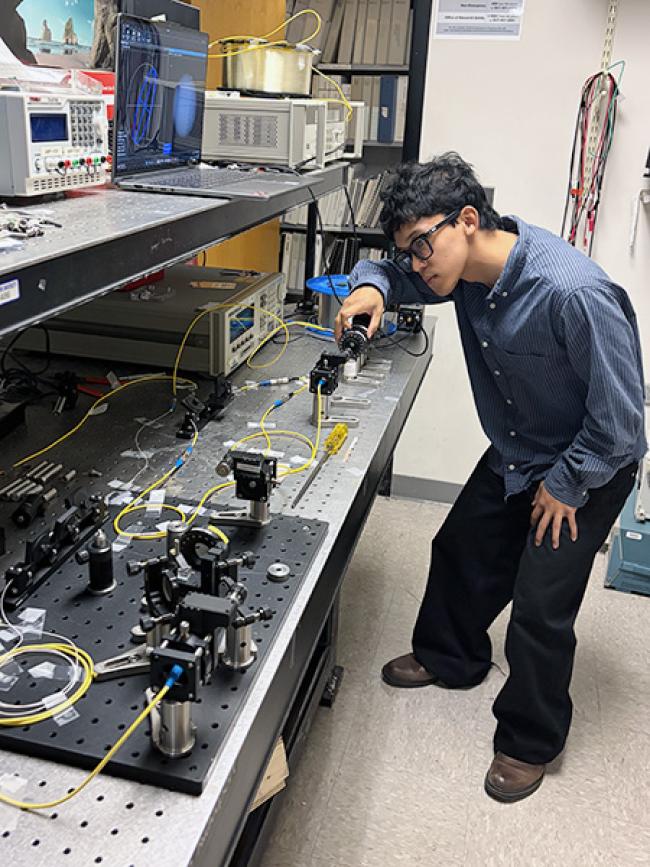
Cholo Ferrolino ’27 in the lab at Northwestern University
Throughout the summer, Ferrolino and his mentor Dr. Gamze Gul met to discuss measurement statistics, sources of error, and how to carefully interpret and communicate experimental data. She said it was great to see his progress throughout the internship.
“I was particularly impressed by how his understanding developed as he worked through the connection between simulations and experiments,” said Dr. Gul. “He gave a strong presentation for OQI midway through … but he continued to learn and perform additional experiments afterward. His curiosity, positive interactions with the group, and willingness to engage with both the experimental and analytical sides of the project made mentoring him a very positive experience,” she said.
From one summer into the future
Ferrolino — who as a sophomore transferred to Augustana from a community college in his hometown of Woodstock, Ill. — credits strong relationships with faculty for many opportunities presented to Augustana students.
“I definitely would not be in this position if I had not transferred to Augustana,” he said. “I think it’s because of the connections you can make with your professors. That’s a big part of it.”
During the summer, Ferrolino joined the other OQI fellows on a trip to Washington, D.C., where they visited the headquarters of IONQ, one of the leading U.S. developers of quantum computing systems.
A possible internship with IONQ next summer holds interest for Ferrolino, who is still narrowing down his professional focus. He had arrived at Augustana as an applied mathematics major, then considered mechanical engineering, and then landed on physics.
Yet physics opens up many more possible career paths. Even at the OQI Research Symposium, as Ferrolino pointed out, “On one side you had people growing crystals, and then for my talk it was networks and fibers and all that. So that was one thing I learned about the quantum space: how broad it is.”
Right now, Ferrolino is thinking he’ll pursue a master’s in electrical computer engineering or applied physics, and then take that degree into the industry.
Meanwhile, excitement is building around quantum physics at Augustana. Students have formed a new Quantum Club, and student researchers are helping Dr. van Howe create a “plug-and-play” entangled photon source on campus. Still others, like Cholo Ferrolino, may take the opportunity to do high-level quantum network research that may help solve humanity’s problems.