
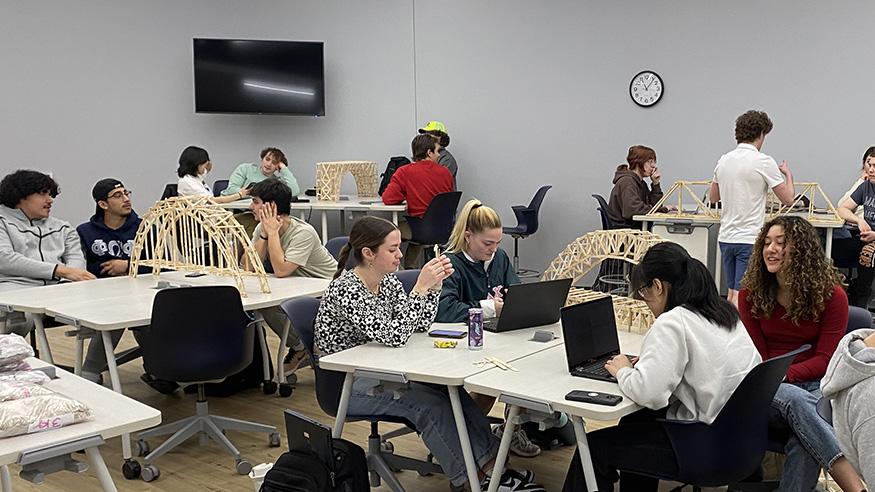
Students in Engineering 310: Statics and Engineering 190: Introduction to Engineering Design test the structures they built.
Engineering students bridge theory and structural testing in showcase
Bridges built from wooden sticks held tens of kilograms before collapsing under pressure as Augustana College engineering students presented final projects during the Spring 2026 Engineering Showcase.
"The moment a bridge snaps is often when the most important learning happens; it’s where math meets reality."
The showcase, held in Hanson Hall of Science, featured work from students in Engineering 310: Statics and Engineering 190: Introduction to Engineering Design, both taught by professor Dr. José Wilches. The event marked the culmination of semester-long projects focused on applying engineering principles to physical models and real-world design challenges.
"This is where students take theoretical concepts and test them in real conditions," Dr. Wilches said. "The moment a bridge snaps is often when the most important learning happens; it’s where math meets reality."
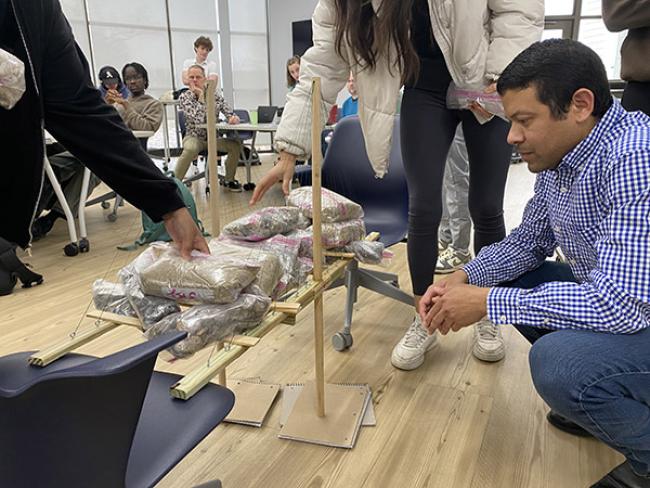
Dr. José Wilches observes students testing a bridge.
Truss structures
In Engineering 310, students designed and constructed truss structures using wooden sticks and adhesive, then tested their designs by applying increasing loads until failure. The goal was to maximize structural efficiency, the ratio between how much weight a structure can support and its own mass.
One project, a Howe truss design, supported approximately 150 kilograms while weighing 1.142 kilograms, resulting in an efficiency ratio of more than 130. According to the students’ report, the bridge remained stable through incremental loading before failing at central joints, where stress concentrations caused buckling in compression members.
The failure pattern reflected a common engineering challenge: joints, rather than primary structural members, often represent the weakest points in a system. Students observed that while top chords handled compression effectively and bottom chords carried tension, joint connections ultimately determined the structure’s limits.
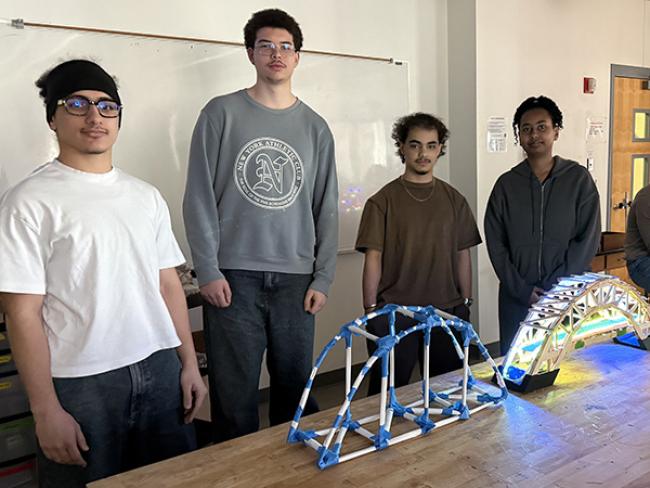
From left, Mohamed Ben Ismail, Wassim ElMabrak, Yasser Ghanimi and Edna Tesfaye present their pedestrian bridge design. The team used AutoCAD and 3D-modeling software to develop the design, then built a physical prototype using wooden materials and 3D-printed components.
Pedestrian and bicycle bridges
Students in Engineering 190 approached the showcase from a broader design perspective, focusing on solving real-world problems. Teams were tasked with designing pedestrian and bicycle bridges that could improve safety and accessibility.
One group, Mohamed Ben Ismail '29, Wassim ElMabrak '29, Yasser Ghanimi '29 and Edna Tesfaye '29, developed a bridge proposal addressing safety concerns along the Great River Trail in Rock Island, where pedestrians and cyclists must currently cross active roadways.
Their design, a tied-arch bridge with integrated truss elements, combined structural efficiency with practical considerations such as durability, cost and environmental impact. The team used AutoCAD and 3D-modeling software to develop the design, then built a physical prototype using wooden materials and 3D-printed components.
The bridge incorporated a custom 3D-printed connector node to improve joint precision and structural stability. This component addressed a key challenge identified during prototyping: multi-member joints, where several structural elements meet, were difficult to align and reinforce using traditional materials alone.
Initial testing showed the structure remained stable under early loads, with a projected capacity between 10 and 20 kilograms before failure. The team also integrated design features such as lighting systems and environmental considerations.
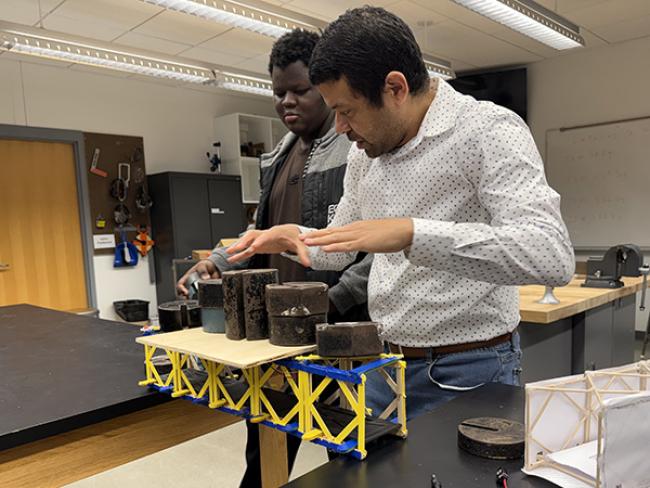
Abhik Mostafa '29 and Dr. José Wilches test the load capacity of a student-designed bridge model.
Electrical towers
Another Engineering 310 project focused on the design of a small-scale electrical transmission tower. Students Juan Jacome '26, Amir Souleymane '29, Mason Landes '27 and Adrian Lutes '27 constructed a truss-based tower using triangular configurations to improve stability and distribute loads efficiently.
The structure, built to meet specific dimensional constraints, weighed approximately 600 grams and supported more than 20 kilograms during testing. The team used triangular truss systems to ensure stability, as triangular shapes prevent deformation under load and allow forces to be distributed evenly throughout the structure.
"We tried to keep the design simple but strong," Jacome said. "Seeing the tower hold far more than its own weight validated the hours we spent refining the truss geometry."
Mechanical systems
Another Engineering 190 project, developed by Amir Souleymane '29, Diego Paredes '29, Bereket Berhanu '28 and Izreal Harper '29, focused on mechanical systems rather than structures. Students designed a fully mechanical transport and sorting device using components such as an Archimedes screw, a balance system and a crank-driven pushing mechanism.
The system demonstrated how rotational motion can be converted into linear movement to transport materials, while a balance mechanism sorted objects based on mass. The project highlighted principles such as force transfer, mechanical advantage and system integration, all without relying on electronic components.
Across both courses, students followed an iterative design process that included brainstorming, prototyping, testing and refinement. Failures during testing were used to identify weaknesses and improve performance, reinforcing the role of experimentation in engineering practice.
The showcase provided students an opportunity to present their work publicly, explain their design decisions and demonstrate how engineering principles apply beyond the classroom.
By Yael Haddad '26