
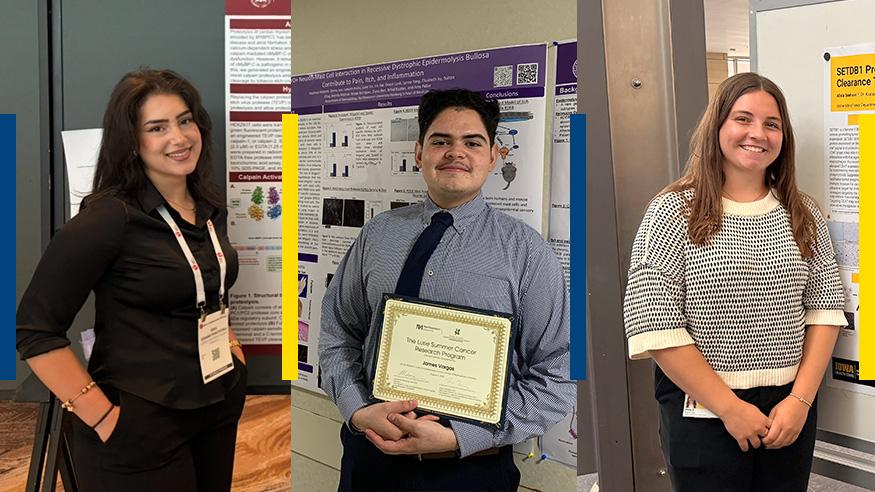
Left to right, Antonina Gramatnikovska ’27, James Vargas ’28 and Alivia Seehase ’28 spent their summers conducting research at Loyola University Chicago, Northwestern University and the University of Iowa, exploring cardiovascular disease, a rare skin disorder and cancer.
Augustana students contribute to work at prominent research universities
For three Augustana students, the path from the classroom to a medical internship took them to some of the region’s most prominent research universities.
Antonina Gramatnikovska ’27, James Vargas ’28 and Alivia Seehase ’28 spent their summers conducting research at Loyola University Chicago, Northwestern University and the University of Iowa, exploring cardiovascular disease, a rare skin disorder and cancer.
Entering large academic research environments can be intimidating for undergraduates, but each Augustana student discovered something important: they were prepared to contribute. Their coursework gave them a foundation they could put to work in professional laboratories, where they conducted experiments and analyzed findings, and then presented their research.
Along the way, they gained a deeper understanding of how their experience could shape their future careers.
Their stories
Gramatnikovska '27 studied enzymes related to cardiovascular disease
Antonina Gramatnikovska ’27, a double major in biochemistry and biology on the pre-medicine track, spent 10 weeks in the Undergraduate Research Cardiovascular Physiology program at Loyola University Chicago’s Stritch School of Medicine.
Gramatnikovska studied cardiovascular disease, seeking to better understand how an enzyme called calpain affects cMyBP-C, a protein important to proper heart contraction. Her goal was to determine whether calpain could break down the protein and where that breakdown might occur.
"Meeting postdocs from Harvard is a dream come true for me because you never know what these connections can lead to."
“Having everything you've learned in theory in school come to life in actual research is like you remember it more and you make better connections to the material because you're actually doing it by yourself," said Gramatnikovska, from Skopje, North Macedonia. "Coming back with this research experience, I am going into my classes, and I can see how much I've learned from that research experience.”
During the 10-week program, Gramatnikovska presented her findings at the American Heart Association’s Basic Cardiovascular Sciences Scientific Sessions 2026 in Boston. Her presentation included the experimental system she helped develop to better control and study how the protein is broken down.
She said the opportunity to connect with researchers at the conference was another highlight of her internship.
"Meeting postdocs from Harvard is a dream come true for me because you never know what these connections can lead to," Gramatnikovska said. "They were from all around the world.This is not knowledge you can get access to every day. These are not connections you can make on the streets."
Gramatnikovska said she will always remember contributing to research for the first time. Her advice to other Augustana students is not to underestimate their preparation.
"If you're coming from Augie, you're prepared," Gramatnikovska said. "You might think you're scared. You might think you don’t have this. But you got this, especially if you're biochemistry."
After graduating, Gramatnikovska plans to pursue an MD-PhD program and is considering which institution would best fit her goals.
Vargas '28 investigated pain pathways in rare skin disorder
James Vargas ’28 is a double major in biochemistry and Spanish for health care use on the pre-medicine track. He was one of six participants in Northwestern University’s Feinberg School of Medicine Lurie Cancer Center Summer Research Internship.
Vargas of Elgin, Ill., spent eight weeks in the lab of Dr. Amy Paller, conducting dermatology research focused on a pain pathway associated with recessive dystrophic epidermolysis bullosa, a rare genetic skin-blistering disorder.
"It's gratifying to me that I was able to contribute in some way to this new field, especially given how rare and under-researched it is."
"Basically what it is, people get chronic wounds and chronic blistering throughout their skin, which is caused and aggravated by any form of mechanical friction or stimulus," Vargas said. "We were looking at a very specific kind of cell within your skin that is involved with immune system responses, and we hypothesized that this specific cell may be releasing certain chemicals into your skin that get picked up by your nerves and then causes your brain to sense them, and you feel the pain and the itchiness."
Vargas and other researchers analyzed different parts of the pain pathway, including how nerves reacted, what was elevated and whether additional signals were being produced. That information could help researchers identify potential ways to target the pathway and reduce patients’ pain.
For Vargas, the experience also provided a new perspective on what he had been learning at Augustana.
"It wasn't until the summer when I was there in the lab that all these science terms that I was learning in lecture, which seemed so minuscule and unimportant, suddenly became so important and gave reason as to why I'm learning and studying the things I'm studying," he said.
"Suddenly the scientific information has an applicable reason as to why I'm using it in the lab for a real purpose where it actually helps people with their disorders and their pain and their daily lives and executing their daily functions," Vargas added. "It's gratifying to me that I was able to contribute in some way to this new field, especially given how rare and under-researched it is."
Vargas concluded his summer research experience with a 20-minute oral presentation for his peers and other researchers in the Northwestern community.
After graduating from Augustana, he plans to attend medical school in the Chicago area and become a physician.
"I would love to give back to my community, either here in the Quad Cities, or I would also love to give it back in Elgin," Vargas said. "I know there's a very big underrepresentation of Spanish-speaking physicians within the field. I'm very proud of being first-generation Mexican American, and I really want to give back to my community in terms of medicine."
Research gave Seehase '28 a different perspective
Alivia Seehase ’28, a double major in biology and Spanish for professional use on the pre-medicine track, spent 10 weeks at the University of Iowa participating in Cancer Research Opportunities at Iowa (CROI).
Seehase, who has worked as a certified nursing assistant since high school, plans to pursue a career as an oncologist or emergency medicine physician. Her interest in oncology is personal.
"Cancer hit my family really hard my senior year of high school," said Seehase, of Sumner, Iowa. "That really drew my attention because I wanted to learn more about it. I lost two of my grandpas within nine months of each other from cancer. I’m interested in becoming an emergency medical doctor because I like the fast pace and seeing so many things every day."
"If you listen to your support system, then you apply for things that you wouldn't have applied for by yourself. That can lead to opportunities you never thought you would get."
Working under the guidance of Dr. Shujie Yang, Seehase researched how endometrial cancer can go undetected by the immune system.
She studied CD47, a protein that can act as a "don't eat me" signal to immune cells called macrophages. Normally, macrophages identify and consume abnormal or harmful cells. High levels of CD47, however, can help cancer cells signal to macrophages not to attack them.
Seehase used live imaging to observe interactions between macrophages and cancer cells. Researchers compared cancer cells with no, normal and high levels of CD47 by knocking out the SETDB1 gene, which regulates CD47. The work helped demonstrate how CD47 allows cancer cells to avoid being consumed by macrophages.
For Seehase, the research offered a different perspective on medicine from the patient care she had previously experienced.
"It was definitely interesting to see the opposite side of the medical field and how they actually intertwine," Seehase said. "The first couple weeks, it was very intimidating. I feel like that's just kind of a normal thing when you're undergrad and you have no research experience and then go straight into a big academic university that is known for their medical research and their hospitals."
Seehase concluded the summer with a poster presentation of her research.
Her interest in medicine also comes from growing up in a rural community, where she saw people who were reluctant to seek medical care as well as those who struggled to access it. Reflecting on her summer experience, Seehase encouraged other students to keep an open mind about opportunities and listen to the people who support them.
“Your support system is going to push you to be who they know you can be," Seehase said. "If you listen to your support system, then you apply for things that you wouldn't have applied for by yourself. That can lead to opportunities you never thought you would get."