
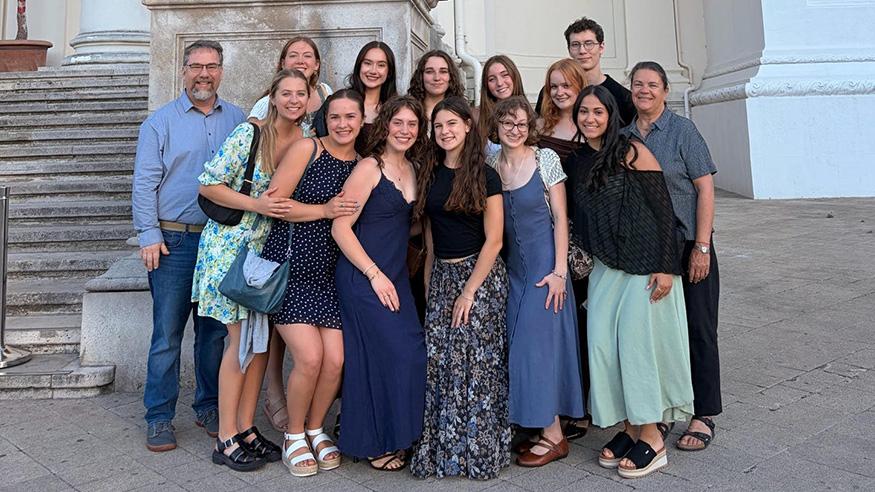
Students and faculty (Dr. Ian Harrington on the left and Dr. Heidi Storl on the right) gather outside St. Charles Church in Vienna before enjoying a performance of Vivaldi's "The Four Seasons."
Austria study away program connects neuroscience, philosophy and culture
This summer, 12 Augustana students took their learning across the Atlantic, traveling to Austria for a faculty-led course that blended neuroscience and philosophy.
Dr. Heidi Storl, professor of philosophy and William A. Freistat professor for Studies in World Peace, and Dr. Ian Harrington, professor and chair of psychology and neuroscience, challenged students to connect their coursework with research, culture and daily life in Austria.
More Augustana students are taking advantage of global learning opportunities, with nearly 35% of graduates completing a credit-bearing international experience, according to the college's recent surveys.
In fact, Augustana is ranked No. 15 nationally among baccalaureate institutions for participation in short-term study abroad programs, according to the latest Open Doors Report. That strong participation is supported in part by Augie Choice, which provides eligible students with up to $2,000 for internships, undergraduate research, study abroad and study away experiences.
Gabriella Davies ’27, Peyton Mattly ’26 and Kiana Breuer ’27 were among the students who traveled to Austria.
Gabriella Davies ’27, neuroscience major and music minor
Visiting Austria introduced Gabriella Davies to a different culture while broadening her understanding of neuroscience.
“This trip made me aware of the many fields of research within neuroscience and how they contribute to the discipline,” said Davies, of Braidwood, Ill.
After graduation, Davies plans to pursue graduate study in neuropsychology. She hopes to use neuroscience tools, including magnetic resonance imaging, to help patients with behavioral disorders or cognitive disabilities.
Davies said meeting internationally recognized researchers expanded her understanding of how scientists study the brain and behavior.
“We met a researcher who studies ravens and crows and helped demonstrate that ravens have complex social networks, memories and the ability to communicate with one another and with people,” Davies said.
She also was especially interested in a lecture about infant language learning.
“We learned about research that uses EEG caps to track infants’ brain activity as they hear and learn sounds,” Davies said. “It was fascinating to see how researchers study language development at such an early age.”
Davies said the trip also allowed students to build stronger relationships with Dr. Storl and Dr. Harrington while observing how their professors’ academic interests connected with the experience.
“I don’t think the trip exists without them,” Davies said. “They challenged us intellectually, supported us personally and showed us the kind of knowledge and curiosity we hope to develop.”
Davies plans to pursue graduate study at the University of Iowa and hopes to build a career in the Chicago suburbs or the Pacific Northwest.
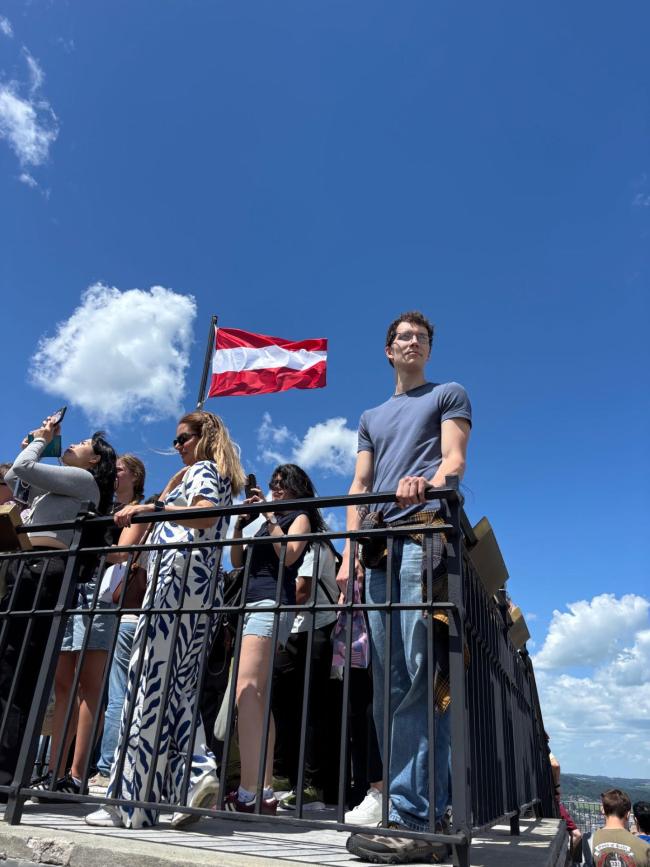
Peyton Mattly at the highest point of Hohensalzburg Fortress in Salzburg
Peyton Mattly ’26, psychology major
Peyton Mattly, who graduated in May, always wanted to visit Europe. Before traveling to Austria, he and his classmates completed coursework in social neuroscience and philosophy of mind that prepared them for research experiences at the University of Vienna.
One of the most meaningful parts of the trip for Mattly was meeting researchers whose work he had studied.
“We saw firsthand the projects they were conducting on campus and at research sites, including studies of crows, corvids and ravens and how they interact with one another,” he said. “Seeing the amount of research underway at the University of Vienna was eye-opening. Being in Europe also was life-changing because I had never been outside the country.”
Mattly, of Moline, Ill., said he became more aware of cultural differences and was especially struck by Vienna’s historic architecture.
“I love old architecture,” Mattly said. “Vienna was full of Baroque architecture and buildings that combined classical, industrial and modern design.”
Mattly said the experience strengthened his global perspective and his ability to empathize with people from a variety of backgrounds.
“It is one thing to read about or learn about something, but it is completely different to experience it,” Mattly said. “Interacting with another culture and trying to communicate in another language opens you to different people, perspectives and ways of life.”
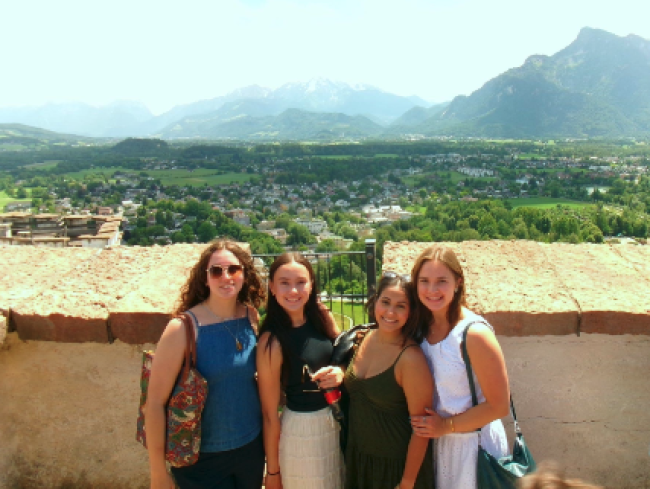
Kiana Breuer, second from the left, with friends at the top of Hohensalzburg Fortress in Salzburg
Kiana Breuer ’27, neuroscience major and philosophy minor
Kiana Breuer of Peoria, Ariz., said studying the intersection of neuroscience and philosophy helped her understand her major through a new academic lens.
“I’m a neuroscience major, and because of this study abroad experience, I’m also minoring in philosophy now,” Breuer said. “Everywhere we went, we found connections to our classes. Even signs, stores and public spaces prompted us to think about how culture influences the way people view society.”
Breuer said those connections also emerged in art museums, musical performances and other cultural experiences in Vienna. One of her most memorable moments was visiting St. Stephen’s Cathedral, known locally as Stephansdom.
“Standing there, you see this enormous, intricate and beautiful church,” Breuer said. “Seeing how much pride people take in those buildings, and how much cultural importance they hold, helped me understand how different communities express what they value.”
Breuer plans to attend graduate school and pursue a career that combines patient advocacy, the medical field and family law. She believes traveling abroad strengthened the cross-cultural communication skills she will need to connect with families from diverse backgrounds.
“Being able to go to another country, communicate, order food at a restaurant and have meaningful conversations with people from another culture builds confidence,” Breuer said. “Studying abroad is one of the most effective ways to develop those skills.”
Experiences such as the Austria program reflect Augustana’s commitment to engaged learning by helping students connect classroom knowledge with international research, cross-cultural experiences and career preparation.