
New endowed chair honors father-daughter legacy in science and teaching
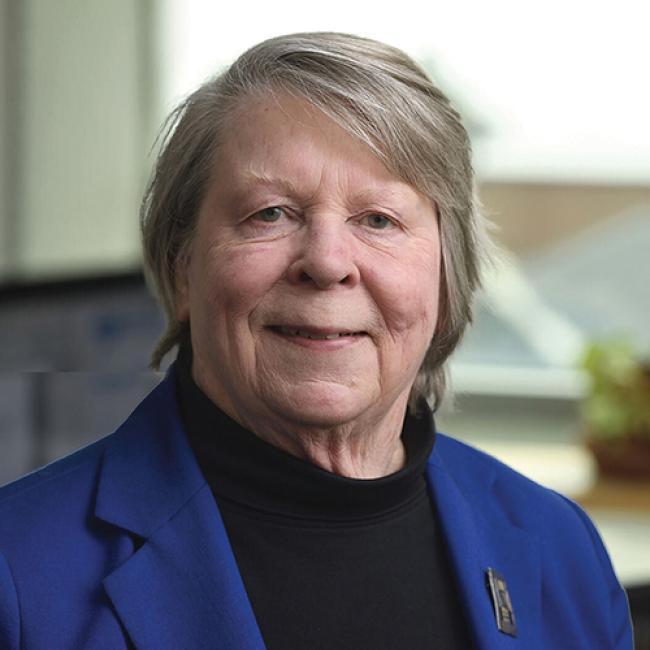
Dr. Diane Edmund ’62 Griffin. Photo credit: Will Kirk/Johns Hopkins University
Dr. Diane Edmund ‘62 Griffin, who passed away in 2024, had asked her family to proceed with an endowment named for her father, Dr. Rudolph Edmund, Class of 1934. She was a pioneering infectious-disease virologist. Her father’s long career alternated between the worlds of geology and teaching.
The endowed chair will be an important position in the new Department of Environment, Geography, and Geoscience as it launches a new major: environmental studies and geography. The chair will help the college attract and retain an experienced professor, strengthening teaching and research. Students will benefit from expert mentorship, engaging courses and more hands-on learning opportunities.
This pursuit of scientific inquiry was equally and vitally important for father and daughter.
“For him, and for my mom as well, studying the world as honestly as you can teaches you a kind of humility,” said Todd Griffin, Diane’s son. “His religious faith and his experience of hard science were one and the same. That really defined his approach and is something that he would wish to carry forward in this position. Geology and environmental science were extremely important to him, and were connected both to the science and his faith.”
The Griffin family sees the endowment as honoring Dr. Edmund’s and Dr. Griffin’s deep commitment to the role that academic science and inquiry play in society and in preparing students for that role.
Deep Augustana roots
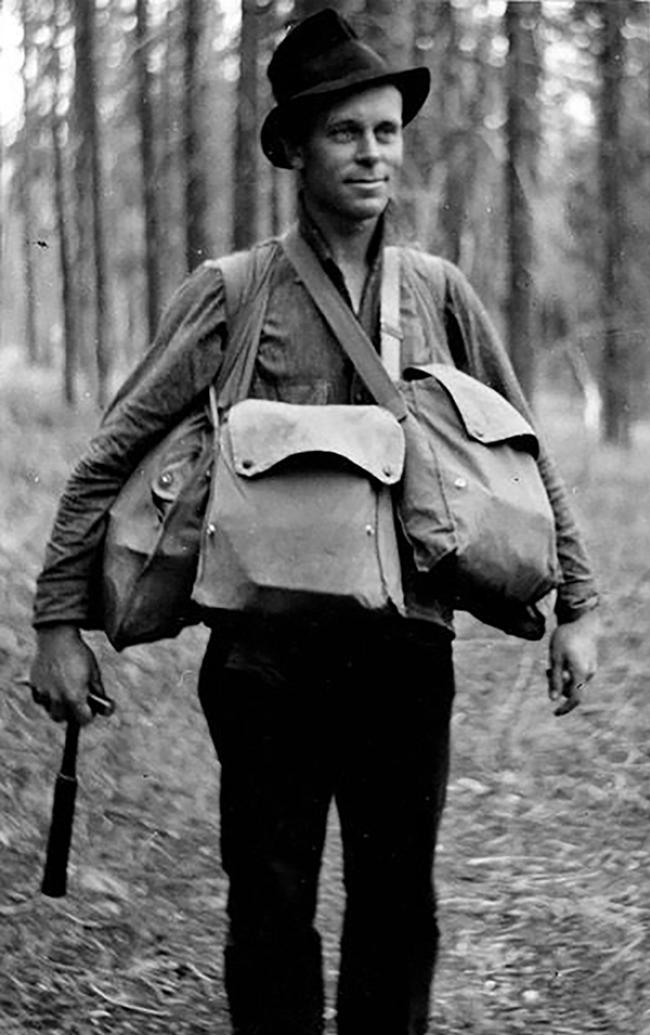
Rudolph "Rudy" Edmund ’34, circa 1939
Dr. Edmund was born May 9, 1910, in Lockridge, Iowa, the eldest of six children. He grew up on the family farm and attended a one-room school and then Ottumwa High School. After working and selling his prize hogs, he was able to start classes at Augustana in 1930.
Although he planned to become a medical missionary, he ran into the legendary Dr. Fritiof Fryxell, who had organized a Department of Geology at Augustana just a year earlier. Dr. Fryxell took him on a field trip to the Teton Mountains in 1932, and that was it. Rudy Edmund would become a geologist.
Diane was born in 1940 in Iowa City, where her father was earning his Ph.D. in geology. She grew up in Oklahoma City and in Rock Island, as her father alternated working in petroleum geology and returning to teaching at Augustana and later at California Lutheran.
Although she learned about science from her geologist father, her curiosity was captured not by rocks, but by viruses. She spent her career studying viruses and how our bodies respond to them. Her work helped explain how viruses impact the nervous system and the immune system.
Diane received her B.A. in biology from Augustana, then earned an M.D. and Ph.D. in microbiology simultaneously at Stanford University, where she met her husband, John Griffin.
At the time of her death, she was chair emeritus of the W. Harry Feinstone Department of Molecular Microbiology at the Johns Hopkins Bloomberg School of Public Health and vice president of the National Academy of Sciences. Johns Hopkins held a “Diane Griffin Day” symposium on May 2, 2025, to honor the legacy, science and mentorship of the internationally known virologist.
Unsurprisingly, father and daughter had a similar world view.
“Both really had incredible integrity and worked very hard to make a contribution to the world,” said Diane’s sister, Janice Edmund ‘65 Mauras. “They really wanted their lives to matter.”
Todd said his mother and grandfather also shared a sense of humility.
“Rudy was a very grounded and humble person, and that is one of the first things you would describe in him, despite all of his accomplishments in his life,” Todd said.
Love of the Earth
Grandson Erik Griffin said Dr. Edmund in his later years wrote a series of booklets, short meditations on writings about stewardship, faith, God and the wilderness.
He was talking about climate change in the '70s, Todd added. “I don’t know if that was specifically driving him out of working in the fossil fuel industry, but it was something he was very aware of way before people were talking about it.”
“Both [Diane Griffin and father Rudy Edmund] really had incredible integrity and worked very hard to make a contribution to the world. They really wanted their lives to matter.”
Dr. Edmund was not able to enlist during World War II because his work as a petroleum geologist was essential. At that time, he felt oil exploration was a patriotic duty, Diane's sister said. Later, changes in the industry caused him to leave it and return to what he really loved: teaching.
According to a memorial by his colleagues at Augustana, Dr. Edmund’s favorite course was "World Resources," a review of the distribution of natural resources, their movement in world trade, their uses, and the need for their conservation. His essays were a vehicle for drawing on his own life experiences and for conveying his reverence for Earth.
Always a teacher
Family vacations with Dr. Edmund invariably included an element of teaching. Janice Mauras remembered camping and traveling every summer as a child. Trips usually meant mountains. “His heart was with his rock hammer, and being out on the mountains,” she said.
Todd reflected that, for his grandfather, traveling was about learning, a philosophy he passed down through the family.
Dr. Edmund and his wife Doris Swanson ’35 Edmund spent many summers at Holden Village, beginning in 1963 when the former mining town in the northern Cascade Mountains of Washington state became a Lutheran retreat.
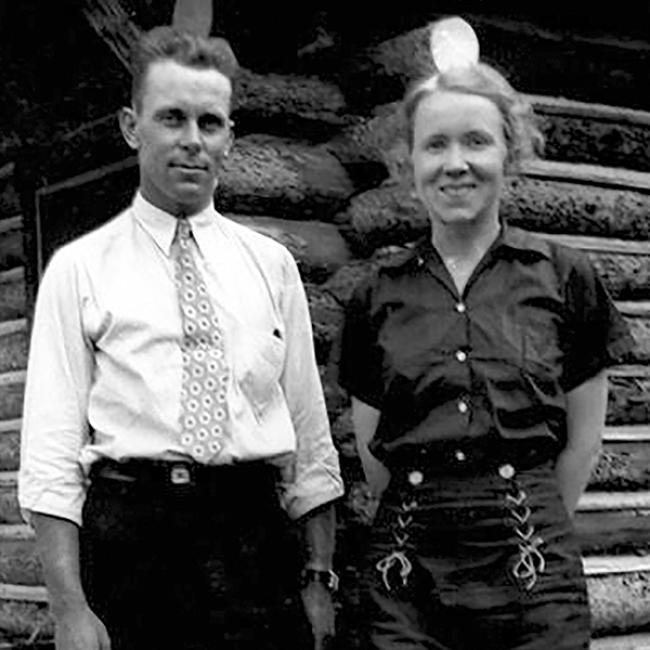
Rudy and Doris Edmund on their honeymoon in 1939, camping in the Tetons.
Dr. Edmund served on the Holden board of directors and preserved much of the mining history in a museum he established. Doris Edmund (who had established the Red Shoes preschool at Augustana) developed a children’s program at the village.
“For me, there’s a very deep connection to Holden Village,” Erik said. “Todd and I would go out in the summers when we were kids and stay with Doris and Rudy at Holden. They would go up there for the academic summer, and he was the village geologist.”
The grandsons remembered many days of hiking, camping and fishing with their grandfather.
“He just loved to immerse himself in that sort of meditative experience, and so I really learned from him,” Todd said.
“He was not a ‘play-with-you grandfather.’ He would let you do the things that he was doing and show you how. He was always teaching, but you never noticed he was teaching.”
Service to Augustana
Father and daughter continued their service to Augustana all their lives. In retirement, Dr. Edmund gave school tours at the Fryxell Museum (which he helped to establish), wearing a name tag that read “Grandpa Rudy.”
And Diane served on the Augustana Board of Trustees from 2013-2021. Her expertise in virology and advice were invaluable to the college’s leadership during the COVID-19 pandemic.
“I think both of them lived exactly the lives that they should have lived,” Erik said. “They were both fully realized in terms of the things that were central to their lives.”
For father and daughter those things were science and teaching, making the Rudolph Edmund Distinguished Chair in Environment, Geography, and Geoscience a fitting tribute to both.