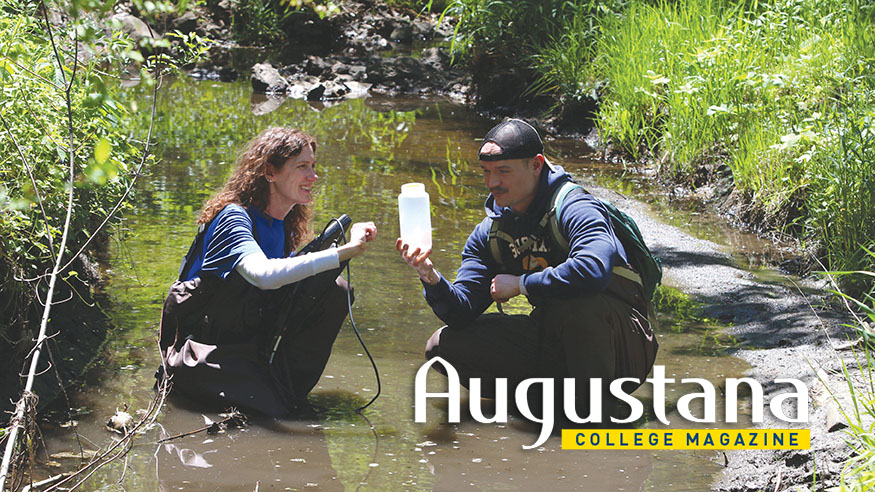
At Augustana, your fascination with landscapes and human-environment interactions can take you down many career paths: environmental management and protection, urban planning, community development, environmental consulting, policy and law, Geographic Information Systems (GIS), cartography, teaching, and more.
Humans live at the intersection of the natural and the built environments, and that’s why environmental studies and geography is a necessary and fast-growing field. Your passion for the environment can turn into working on solutions for the environmental challenges of the 21st century!
Augustana's major and minor in environmental studies and geography helps students understand environmental and geographic problems so they can navigate complex issues at multiple scales and begin to influence change. In the program, students use social and natural science techniques and geospatial technologies to understand key global and local issues, including climate change, sustainability, urbanization, resource management and environmental justice.
In addition to courses in environmental studies and geography, you'll take related courses in biology, geology, political science, economics and sociology and anthropology. Making connections with disciplines related to environmental and geographic issues is an important part of our liberal arts approach to creating active leaders and problem solvers of the future. Through your professors’ connections to community partners and resources, you’ll find career-boosting opportunities such as internships, and work and field experience in the Quad-Cities metro area along the Mississippi River.
Many students complete internships with local agencies, such as the U.S. Army Corps of Engineers or U.S. Fish and Wildlife Service, or non-profit groups, such as River Action. During your senior year you'll complete a research project, choosing from three different options that fit your interests and career plans.
You’ll also embark on field trips with class groups or the whole department, investigating site-specific issues and exploring the geography of more distant places. Recent destinations include the Louisiana Gulf Coast and northern Sweden.
Augustana also offers a minor in geographic information science and technology (GIS), which focuses on skills in geospatial analysis. Students can also enroll in a 3+3 Master of Landscape Architecture coordinated degree program with University of Illinois at Urbana-Champaign.
Humans live at the intersection of the natural and the built environments, and that’s why environmental studies and geography is a necessary and fast-growing field. Your passion for the environment can turn into working on solutions for the environmental challenges of the 21st century.
Distinctions