
The story of America? Whatever it is, the young people need it
by Dr. Lendol Calder and Beth Roberts
In the Trump era, history and civics education are under a microscope, if not a wrecking ball. As Dana Goldstein has reported in The New York Times, curricula are being withdrawn, lesson plans deleted and teachers silenced. The debate is framed as a battle over content: which version of American history should be taught, which stories are permissible, which voices are excluded.
But here’s the deeper problem: our students don’t need “better” history. What they really need are better ways of learning history.
Perhaps most urgent right now is the need for narrative literacy — the ability to weigh stories, distinguish plausible accounts from propaganda, and recognize that history is always shaped by choices of inclusion and omission. Without that skill, no curriculum, however well designed, will prepare young people for democratic citizenship.
"Our students don’t need 'better' history. What they really need are better ways of learning history."
The students entering college today are largely “unstoried.” They no longer carry in their heads a story of America that explains the nation and makes them proud to belong. For generations, young Americans grew up with a story — often simplistic, certainly mythic — that gave coherence to the nation’s past and purpose to its future. Today, many students arrive in our classrooms without such a narrative.
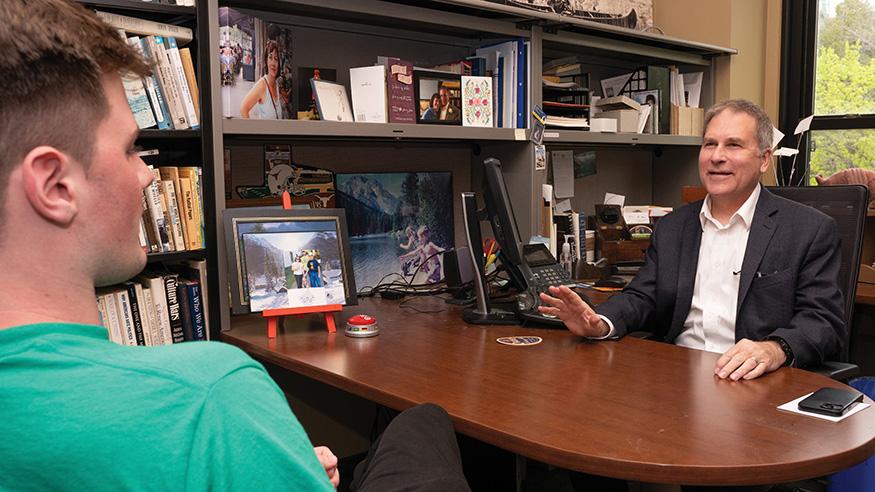
I know this because, at the start of every term at Augustana College, I ask students to answer this prompt: What is the story of America? Thirty years ago, just about every response to the question characterized the arc of America’s past as a quest for freedom. Today, that story is all but extinct.
What do students say, instead? Their understanding of American history is limited to fragments — Columbus (a fool), slavery (wrong), civil rights (a good thing!), Vietnam (unnecessary!), 9/11 (tragic!). Few can articulate a narrative that explains how the facts they know fit together, much less a story that gives meaning to the nation and makes them proud to be part of it all.
That absence is what I mean when I say they are “unstoried.” That absence is not just an academic concern. It also has civic consequences.
Stories are how we know who we are, and what we are to do next. Without a story of America they can believe in, students struggle to imagine themselves as part of a larger “we.” They may be engaged, passionate, even activist — but without a shared narrative, to which they contribute, they feel disconnected from fellow citizens.
Without a national story, inclusive democratic politics itself becomes impossible.
"Stories are how we know who we are, and what we are to do next. Without a story of America they can believe in, students struggle to imagine themselves as part of a larger 'we.'"
If the absence of a shared story leaves young people unmoored, the answer is not to hand them a single “better” version of the past. That only propagates the mistake of treating history as fixed and uncontested. What we need instead are better ways of teaching history — approaches that cultivate narrative literacy, equipping students to analyze, question and debate the stories they encounter.
Narrative literacy means giving students the tools to ask: What stories about America have been told over the years? Who is centered in these stories? What is omitted? What kind of future do these stories invite us to imagine?
It means helping them distinguish plausible accounts from unbelievable mythologies. And it means teaching them to recognize a truth, voiced by physicist Niels Bohr, that the opposite of a true story is not always a false one, but sometimes another true story.
I see the power of this approach in my students’ reactions. When they read the “1619 Project” alongside the Trump-sponsored “1776 Report,” or Jill Lepore’s “These Truths” beside Howard Zinn’s “A People’s History,” the room comes alive. At first, many are startled by how differently the same nation’s story can be told. But as the debates unfold, they begin to notice patterns: what each account emphasizes, what it omits, how evidence is marshaled and how values shape interpretation.
One student once remarked, “I didn’t realize history could argue with itself.” That moment of recognition — that history is not a single voice but a contested conversation — is exactly what I want them to carry into civic life.
Moments like that matter far beyond the classroom. When students realize that history argues with itself, they begin to see democracy differently, too. They understand that citizenship is not about memorizing a single official story, but about engaging in an ongoing debate over competing narratives. That skill — the ability to weigh, question and reframe stories — is what prepares them to resist misinformation, to argue without losing love, and to imagine a shared future even in times of division.
The health of our democracy depends not on one story winning the classroom, but on citizens deliberating together over the stories that will shape our future. Teaching that skill — narrative literacy — is the essential work of history education today. And learning that skill is essential to our American democracy, if that is what we want.
About the authors
Professor of History Dr. Lendol Calder received the American Historical Association’s 2025 Eugene Asher Distinguished Teaching Award, and was a finalist for the 2026 Robert Foster Cherry Award for Great Teaching.
Beth Roberts is a senior strategist for institutional storytelling and reputation at Augustana.
Rethinking American history
Calling all lifelong learners — here are five books from the courses Dr. Lendol Calder currently teaches.
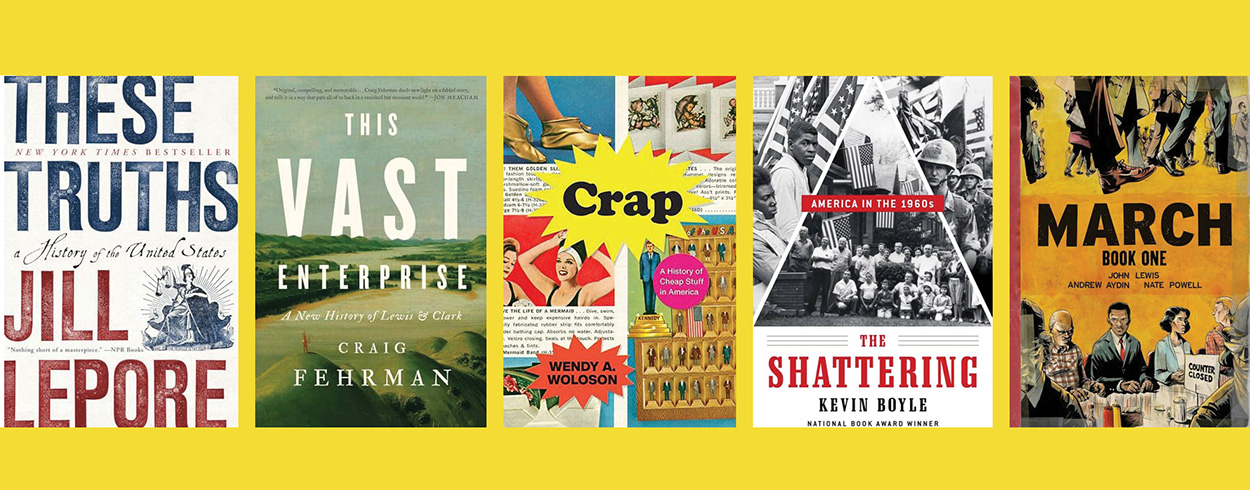
HIST 131 Rethinking U.S. History: Jill Lepore, “These Truths: A History of the United States”
The first comprehensive history of the United States written since Howard Zinn’s “A People’s History of the United States” (1980), Lepore’s book soars over all others. It is jaw-droppingly informative, page-turning and, finally, inspiring for those who yearn and work for a decent, civil democracy.
HIST 335 American West: Craig Fehrman, “This Vast Enterprise: A New History of Lewis & Clark”
Fehrman does something no one has done before: he tells the story of the Corps of Discovery through the eyes of members of the expedition, with chapters told from the points of view of Sergeant John Ordway, Sacajawea, York, Black Buffalo and of course, Lewis and Clark. New research turns up surprising information on nearly every page.
HIST 336 A Consumers’ Republic: Wendy Woloson, “Crap! A History of Cheap Stuff in America”
In The Journal of American History, the first line of my review of this book reads: “This book is full of crap!” And it is! Collectibles, gadgets, knick-knacks — all the stuff crowding our junk drawers and storage units is taken seriously here, proving again that “everything has a history.”
HIST 338 America’s Long Sixties" Kevin Boyle, “The Shattering: America in the 1960s”
Historians of the Sixties often stereotype white working-class Americans. Focusing on American history from the late 1950s to the early 1970s, Boyle takes “the Silent Majority” seriously without turning a blind eye to their shortcomings. And, he knows how to tell a good story.
HIST 345 Black History: John Lewis and Andrew Aydin, “March” (a graphic novel trilogy)
The Southern Black Freedom Struggle, rooted in the Black Church, offers some of the most stirring, dramatic and consequential stories in American history, with enduring lessons for future activists.