
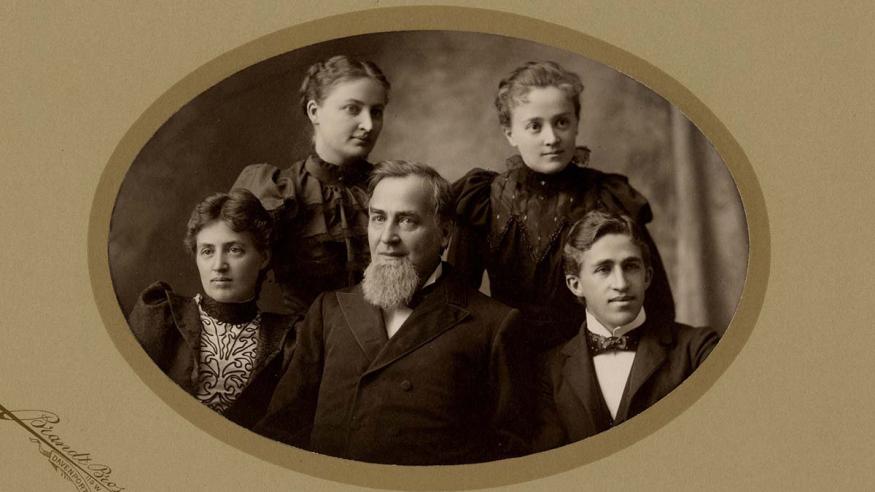
Lydia Olsson (back row, on the right) in a family portrait; her father, Olof Olsson, was president of Augustana from 1891-1899. Courtesy of Tredway Library Special Collections
Hopman '11 found her future in the past
If she had chosen a different college, Rebecca Hopman ‘11 would never have met Lydia Olsson, one of the most important people in her life.
And Hopman might not have embarked on her fulfilling career as a librarian/archivist.
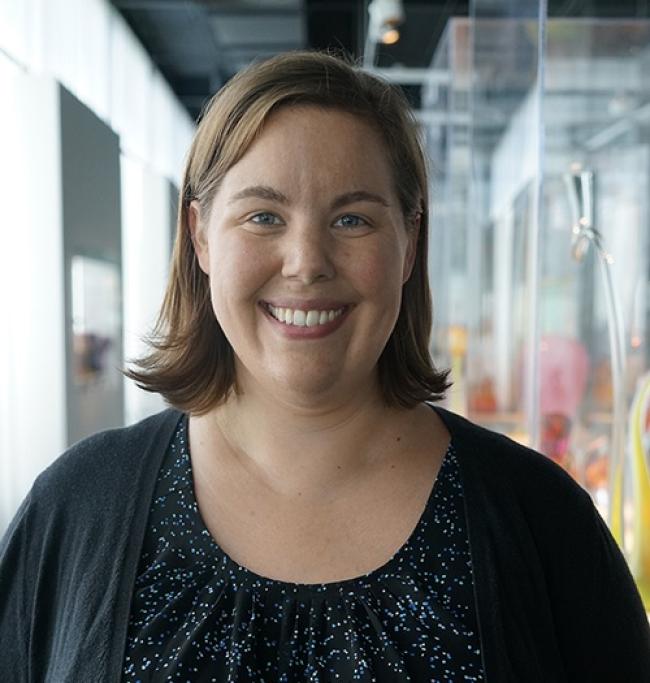
Rebecca Hopman '11
They could never have met in real life, as Olsson died in 1958. They met in the Special Collections room at Augustana’s Tredway Library, where Hopman chanced across Olsson’s diaries.
Hopman had begun her studies at Augustana with the idea of becoming a children’s librarian. Then she got a job in Special Collections.
“My experiences in that student job, including reading Lydia Olsson's diaries, convinced me that I wanted to train as an archivist and orient my career around making history accessible to the public,” she said. “I haven't looked back since!”
Originally from Lake Zurich, Ill., Hopman knew she wanted a small liberal arts college experience. “Honestly, something was just so charming about Augustana, the hills and the architecture … a beautiful campus,” she said “I really had very thoughtful and caring teachers, and I'm so glad that I found Lydia.”
Hopman left Augustana with a B.A. in history, English and German, and a minor in medieval and renaissance studies. She earned an M.A. in women’s history from Sarah Lawrence College and a Master in Library and Information Science from the University of Maryland, College Park.
Today she is the genealogy services librarian at the Wisconsin Historical Society in Madison, where she helps people connect with their past. She also reviews books and writes features for Booklist, the American Library Association journal.
Meeting Lydia Olsson
Born in 1874, Olsson was the youngest of three daughters of Olof Olsson, president of Augustana from 1891-1899. She left behind five diaries that chronicle a few years in the life of a young woman, daughter of immigrants, who is finding her way in the 1890s.
The entries, Hopman writes in her personal blog, “are rich with the details of Olsson’s everyday existence, so full of personality that she practically jumps off the page. It is as if she is sitting next to you, telling you about her day.
“I was immersed in the daily life of a young woman attending Augustana College, just as I was doing almost 120 years later. She took a variety of courses, had a robust social life and was close to her family. She joked about the young men on campus who were vying for the attention of their fairer classmates, thought seriously about the role of religion in her life and contemplated her future.”
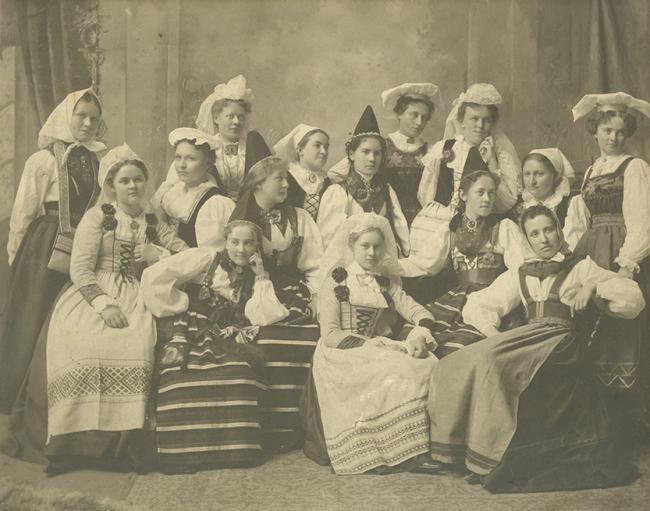
Lydia Olsson (front row, second from the left) in Augustana's Ladies Chorus, 1898.
Olsson was a librarian at Augustana College and Theological Seminary, which may be another reason behind Hopman’s strong connection to her.
Tredway Library Director Stefanie Bluemle ’02 finds the story of Rebecca and Lydia's relationship across time to be very moving.
“It speaks to Lydia's vibrancy and historical significance, as well as Rebecca's curiosity and empathy,” Bluemle said. “Their story also highlights the contributions of Special Collections to teaching, learning and student engagement at Augustana. Rebecca is one notable example of a student for whom Special Collections sparked something powerful and lasting.”
An unfinished portrait
There is still much Hopman would still like to know about Olsson. Unfortunately, no more diaries are known to exist, although she can tell from the gaps in entries that there were more.
"Olsson forged her own path,” Hopman wrote. “While in many respects she was a fairly ordinary, Swedish-American Midwestern woman, she also toured Europe twice, took college courses, and remained unmarried and childless. Her diaries provide critical insight into her life and how she conformed to and rejected the roles society assigned to women like her."
Her sisters, Anna and Mia, also lived single lives. And all of them lived with their father and brother Johannes in their house on the edge of campus.
The eldest, Anna, was the second woman to graduate from Augustana, a published author and English instructor at the college. The middle sister, Mia, was an accomplished dressmaker who patented a hook device as a precursor to the zipper.
Her sisters set an example of having full lives without being married, and a large number of Olsson’s closest friends also didn’t get married. Hopman learned that Olsson, who often read the novels not approved for the college library, turned to Louisa May Alcott’s “Little Women.”
As Olsson navigated relationships, college, friendship, sisterhood and grief, she saw her own experiences reflected in Alcott's seminal work, according to Hopman. Today, Olsson's diaries can be read as a time capsule of the 1890s.
It’s possible that the world will hear more about Lydia Olsson. Hopman, who has been invited to join the board of the Augustana Historical Society, has a book in mind.