
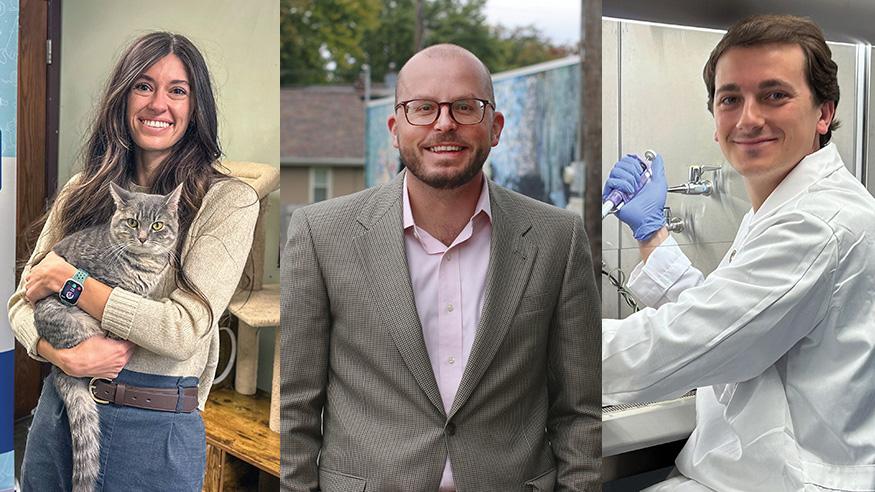
Celina Rippel ’21, Tanner Osing ’18 and Peter Alfano ’20 are three of the countless Augustana alumni who had two or more majors.
When multiple majors lead to singular careers
Making connections is the beating heart of many careers: connecting one idea with another idea, a community with a service or solution, a vision with an audience. A liberal arts education builds this ability. For students who take it further by combining two or more fields that may seem unrelated, a career path opens up to more opportunities — or a unique position that suits them perfectly.
About 50% of Augustana students graduate with two or more majors, compared to the national average of 25%.
For Celina Rippel ’21, it was business administration and graphic design, which became the foundation for her work “connecting people who love animals with ways to make a real difference in our community.”
Rippel is the development manager at the Humane Society of Scott County in Davenport, Iowa.
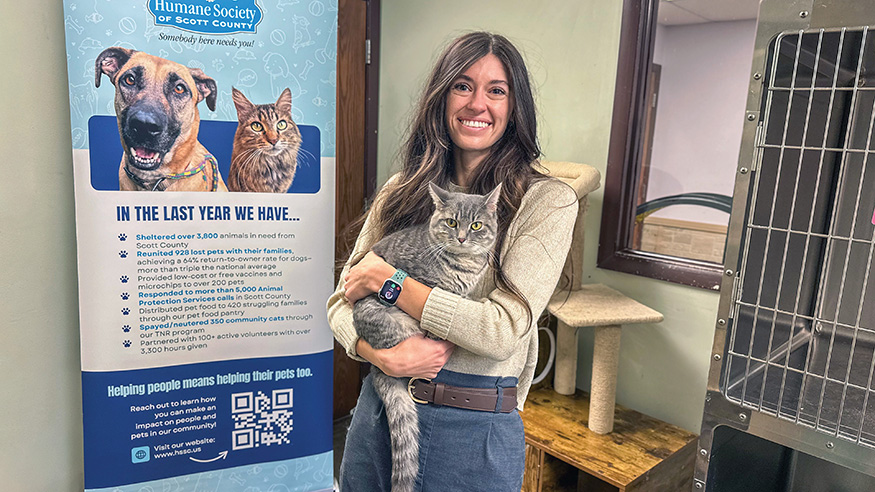
Getting to hold clients is one of Celina Rippel’s job perks at the Humane Society of Scott County.
She joined the Humane Society during a leadership transition in 2021. Immediately she put both of her majors to work. “I wear a lot of hats because that’s just how it goes in the nonprofit world,” she said. “My days are spent building relationships with donors, sponsors and grant funders; writing proposals; coordinating PR and media stories; and keeping our communications engaging and on brand.”
That’s where Rippel’s graphic design degree shines. “We don’t have a dedicated marketing or design department, so I put those skills to use right away, designing everything from staff shirts and event banners to vehicle wraps and social media graphics. Having strong, consistent visuals has made such a difference in how we connect with our community and tell our story.”
Rippel has discovered that her professional “sweet spot” is a blend of strategy and creativity.
“My business degree taught me how to build relationships; my design degree taught me how to make people want to engage with what I have to say,” Rippel explained. “Both have shaped how I approach my work and have allowed me to make a bigger impact than I could with just one skill set.”
Bridging disciplines through a double major encourages what Tanner Osing ’18 calls “holistic thinking.” He finds this perspective incredibly valuable to his work as the planning and zoning manager for the City of Rock Island.
“City planning, by nature, is a multidisciplinary field that brings together geography, design, public policy, economics and public health,” he said. “A double major teaches you how to connect these dots, and helps you avoid thinking in a vacuum.”
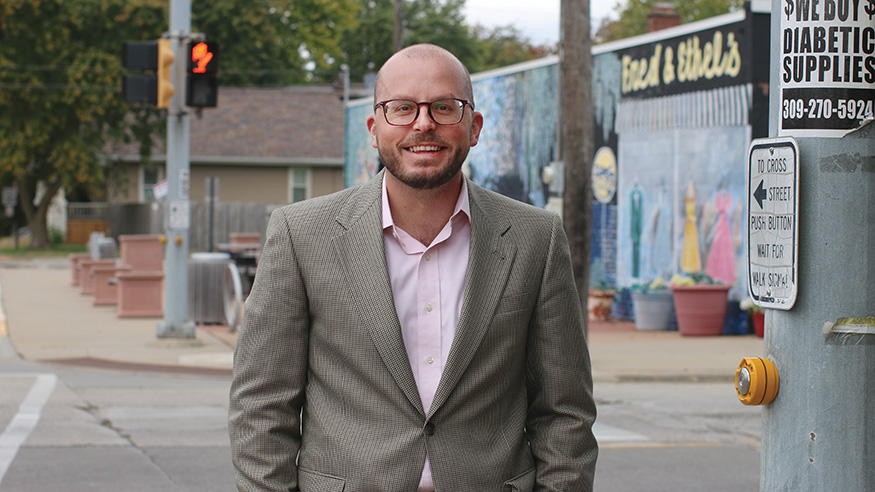
Tanner Osing’s job takes him all over Rock Island, including the College Hill District.
For Osing, those majors were geography and public health, a combination that helps him make decisions related to land use and development in the community.
“Every decision about zoning, land use, transportation or housing is rooted in understanding spatial relationships, which ultimately shapes how people live and move within their community,” he said. “The public health connection comes through in how our planning decisions influence physical and social determinants of health.
“For example, zoning policies can affect things like access to food, walkability, and even mental well-being.”
Osing discovered his second major, geography, while taking a supporting course for his public health major. The course was about urban design and sustainable cities, taught by Dr. Chris Strunk. When the class read the book “Happy City” by Charles Montgomery, Osing said he “became immediately gripped” in learning how urban design affects health outcomes.
“This connection lit a fire in me,” he recalled, “and it was difficult to separate the two disciplines after that point. I felt compelled to pursue a career that combined both areas, and that’s how I landed in urban planning.”
Sometimes it’s outside class where the first sparks fly. Rippel’s experience as a project manager in Augustana’s EDGE Entrepreneurial Center is what inspired her to add a graphic design major.
“Augustana made it easy to explore different interests and combine them in meaningful ways,” she said.
This is something that Dr. Dara Wegman-Geedey sees all the time, in her work as both a biology professor and advisor for students in pre-optometry, pre-nursing and public health.
“Often that second major can allow you to explore interests, and often that interest allows you to bring something to your profession.”
“Often when my advisees declare their majors, I’ll ask them what their interests are, besides what their career goals are,” she said. “Because often that second major can allow you to explore interests, and often that interest allows you to bring something to your profession. I try to help them understand that they’re not one-dimensional.”
Dr. Wegman-Geedey recalls when even the social and biological sciences were not so closely aligned. Today it’s common for Augustana students interested in health careers to combine psychology and biology, for example. In 2014, Augustana was one of the first liberal arts colleges to introduce a major in public health, which is interdisciplinary by nature.
“Now the MCAT requires introductory courses in psychology, in sociology,” Dr. Wegman-Geedey said, “and not calculus.”
She herself was an art minor in college, and this has helped her teach about invisible things such as microbes.
“Studio art gave me the ability to see things, and to imagine and put images together.” Because of her art background, she can better explain concepts to those who want to “see” what they are studying.
Is any combination of fields too odd, too challenging? Not as long as people remain complex individuals, and especially if they are educated to see things from more than one perspective. This is the liberal arts model.
And yet, some combinations are more unusual than others. “People are always shocked when I tell them my two majors, and I love it,” said Peter Alfano ’20, who majored in biology and theatre performance.
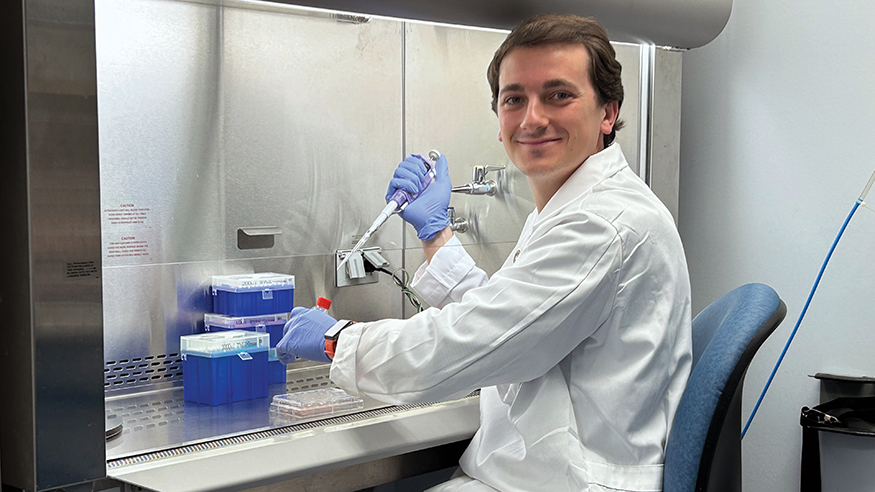
Peter Alfano at the biosafety cabinet, where he does a 24-hour incubation with B cells, a type of white blood cell.
Alfano is a researcher in the microbiology/immunology department at Midwestern University in Downers Grove, Ill., currently researching the effects of B cell lymphomas and immune cells on asthma, among other things. He’s also in a production of “Georgiana & Kitty: Christmas at Pemberley” with Buffalo Theatre Ensemble in Glen Ellyn, Ill.
“I would say that the combination of theatre and sciences is underrated,” Alfano said. He maintains that both of his majors help him throughout the professional and personal aspects of his life.
In fact, the confident presence and communication skills Alfano developed through theatre performance helped him land his job. His theatre experience continues to support him when he presents research to professional peers and scientists at conferences and meetings, and in his day-to-day interactions at work.
Then there’s the impact of a science background on his theatre life. Alfano said he can analyze scripts and think both logically and creatively. The connections he makes daily between his two fields reinforce his dedication to both.
“I think that Augie provides an incredible opportunity to broaden your studies while in school,” Alfano realized.
“I double majored solely because I was interested in two specific fields, but I didn’t understand how beneficial that would be to me after graduating. It allows you to stand out in résumés, or at the least create an ice breaker for job interviews and meeting new people.”
Rippel calls double majoring a smart move. “It shows curiosity, adaptability and a willingness to connect ideas in new ways. The people I look up to most in my career all have that same drive to keep learning, and double majoring gave me a head start on becoming one of those people.”
Each of these three Augustana graduates — the wearer of many hats, the multidisciplinary leader and the theatrical scientist — is “one of those people.” But they also are building career paths that are uniquely their own.